Is Donor Support Good or Bad for Business as Mission Companies?

https://lh6.googleusercontent.com/LkcN3V0z6qfw0-lUcX3aJBO9YQKDQEerjoPVRa4DuardEi_kdRyczhGyRqyMGvZKZGaCBSfDvY5R_F9k9ji0GKKk0uV-yjH6XMre7yKFmad3lmg8sEQYtzdDyDsApg

Business as Mission has been a strong and growing segment within the modern tentmaking movement. The model attracts a lot of attention because it holds out the possibility of being self sustaining because it can generate its own income. It is sometimes the only model that is legal in countries that exclude foreign religious workers from entrance.

One issue that often comes up is the source of funding for the workers. On the one extreme there are those who are completely donor supported and run a business for the other advantages of doing business as mission. On the other end of the spectrum are workers who are solely supported from the fruits of their business. And in between there are a variety of hybrid models.

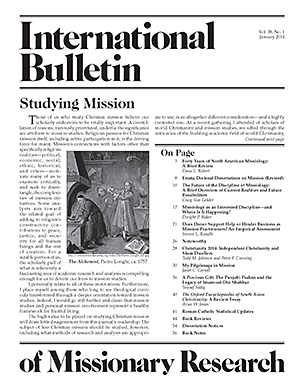
A new study produced by Dr Steve Rundle – author of Great Commission Companies – expands our understanding and provides fuel for further reflection. In his recently published article in the International Bulletin of Missionary Research Rundle examines the question, “Does Donor Support Help of Hinder Business as Mission Practitioners?”

There is no end of opinions about which model is best. Strong cases are made by the proponents on both sides. What has been lacking is strong empirical research to illuminate the discussion and aid in making the best strategic decisions. Most of the evidence is anecdotal with only a few studies to guide the discussion. Those familiar with the debate will know the arguments for both sides. I will not try to cover them here. My purpose here is to highlight the main findings of this new study and encourage the reader to explore the entire article for himself.

Some of the findings provided stronger evidence for conclusions suggested by earlier studies, while other finding were surprising.

“The evidence presented in this article suggests that, for a BAM business to have a meaningful impact in a community, it should be structured and incentivized much like a “regular” business, which includes (1) an independent board of directors and (2) salaries that are based, at least in part, on the company’s performance.”

The study focused on testing two economic hypotheses. The first was based on the assumption that BAMers who depend on their business for all their income will devote more time and energy to the business and will therefore generate more revenue. It is expressed:

“Hypothesis 1: Business-supported BAM practitioners will have a greater (more beneficial) economic impact on the local community than their donor-supported peers.”

The second hypothesis is based on the assumption that donor-supported BAMers will have less pressure to grow the business and thus will have more time to devote to producing spiritual fruit. It states:

“Hypothesis 2: Donor-supported BAM practitioners will be more effective in producing spiritual fruit than their business-supported peers.”

A questionnaire was given to about 200 self identified Business as Mission practitioners and their responses were analyzed on a number of dimensions.

“This study found that, compared with fully donor-supported BAM practitioners, those who are fully supported by their Business report significantly better results in the economic and social arenas, and are no less effective in producing spiritual results.” [emphasis is from Rundle]

As expected the first part of the finding supports hypothesis #1. Those more focused on developing the business grew their businesses more and produced more income. This not only helped the BAM person directly, but enabled them to have more impact on bringing social benefit to their community.

The second half of the finding was counter-intuitive and did not support hypothesis #2. No evidence was shown that those spending less time developing the business were more effective in producing spiritual fruit.

In the full article the author presents cautionary qualifications to how far the findings can be applied and issues that need further study. He concludes:

“One thing we can say with certainty is that the questions raised by the integration of business and missions will keep mission scholars busy for a long time!”

BAM in a Box

Business as mission is growing in popularity as an approach for outreach around the world. Many practitioners are looking for ways to produce more businesses that will also take God’s love and the gospel to the needy. Lately, they have been looking to franchises as a way to develop business faster, easier, and with a greater chance of success.

The idea of being able to take a known concept that is working and multiply it is attractive and shows some promise. The Business as Mission Think Tank Franchising Committee has been studying models for rapid replication and recently issued their report. They analyzed the state of the knowledge, proposed guidelines, and recommended resources on the “how-to” for would be BAM practitioners.

This article highlights key findings.

Many people getting into Business as Mission are missionaries, often with little business experience/skills, who recognize the opportunity in business as a way for reaching their communities. For them a franchise is like a boxed product that comes with a proven successful model, training, resources and systems to help secure success. The built-in processes provide safeguards to help the less experienced avoid foolish mistakes and failure.

These advantages are desirable not only for the would-be BAMpreneur but for missions agencies and others in the business community looking to multiply BAM opportunities. While the franchise can help business people avoid problems, it is not a cure-all for success. Business aptitude and skills are required, to varying degrees, for all who would enter the world of BAM. Agencies sometimes overlook this fact as was observed in the report, “While agencies will go to great lengths to make sure that people are prepared missionally, they discount the skill set required to do business.”

Building a successful franchise is more difficult than it appears. Few proven BAM franchising models exist. BAM franchising has a lot of work to do to build the necessary expertise.

The report lists a number of best practices, which lead to success, and worst practices which lead to failure. These are worth studying but there is not time in this article to enumerate them. Follow the link at the end to the full report for more information.

A few findings stand out in the report:

1. “Some of the businesses in the profiles had leadership teams where some of the people focused on the business and some on the ‘ministry.’ This divided approach to management and leadership eventually causes tension and can negatively impact the business morale, health, and financial success.”

2. Those looking to get into franchise business need to seriously equip themselves with the necessary skills and expertise.

3. Every BAM business needs to develop a list of success criteria and measure themselves against it as they build the business plan and begin to execute it.

4. Running a BAM operation is complex and requires preparation and strong commitment. One must have the conviction that God is calling you to such an endeavor.

5. There seems to be no shortage of people who want to be experts, advisors, and consultants. What is most needed are people willing to go and be “feet on the ground.” “We need people who are fully equipped and willing to go and invest time and money to start such businesses.”

It seems that the committee was looking to create franchises out of existing BAM companies. One area not explored in the report which may have value is to start with existing “secular” franchises. There are literally thousands of them with varying levels of expense, regulation, and complexity. Many have already developed assessment tools to identify the best fit between the entrepreneur and their business model. Could any of these franchises and tools be adapted by BAM practitioners?

Franchising has many advantages, but also challenges. The BAM Franchise group has created a number of tools and guidelines to help get started.

Of Giants and Men

“Sometimes people of faith do not understand that with the spirit of the Lord you are not the underdog.”

http://globalopps.org/tmbriefs/david_and_goliath.jpg

Inspiration can be found in the most unexpected places. Out-of-the box thinker Malcolm Gladwell known for books like the Tipping Point and Blink was interviewing to promote his latest book, David and Goliath. The short video was filled with surprises.

Who would imagine a staff writer for the New Yorker magazine writing about a 3000 years old Biblical account. But then he is an out-of-the-box person.

His purpose was to study situations where the powerless came up against the powerful and the dynamic for handling the encounter. Along the way he was surprised by his findings. There are many parallels in modern social interaction where the lessons learned can be applied.

Gladwell takes a fresh look at a familiar old story and concludes we may have got it all wrong all these years. He digs deep investigating the history and culture surrounding the combat.

The story is told as if David was a long shot to come out on top in the conflict. However, when one understands the power of the weapons in David’s favor the scales tip. He should have been seen as the favorite.

Gladwell discovers from the story of David and other historical accounts that the weak have three weapons they can use when confronting challenges – faith, courage, and determination. These turn out to be powerful enough to overcome their foes. Of the three weapons, Gladwell discovers that the most powerful is one’s faith. One “cannot read the story without coming away with a renewed appreciation for the power faith gives people.”

He then looks at other examples in the human annals to draw some surprising conclusions.

Tentmakers and Business as Mission practitioners will take heart as they re-visit the story of the weak confronting overwhelming odds. When giant obstacles come your way, take heart. Faith is the victory that overcomes the world.

He recently recorded a TED talk where he tells the story of David and Goliath as he understands it after his research. The reader will learn new facts about that combat and have a new appreciation for the narrative in Scripture.

This last clip from his interview while promoting his book reveals how through his research he has been drawn back to the roots of his faith. (7 minutes)

Malcolm Gladwell’s book David and Goliath: Underdogs, Misfits, and the Art of Battling Giants is currently #3 on the New York Times non-fiction book list.

Hope for Africa? Trend Studies Reveal Looming Crisis and Opportunity

http://globalopps.org/tmbriefs/scales.jpg

Africa caught my attention when two recent economic studies crossed my computer screen this month within hours of each other.

The amazing, surprising, Africa-driven demographic future of the Earth, in 9 charts, a UN Population Division study, projects that Africa is the place to watch. The indicators are that it will outstrip the other continents in economic as well as population growth. It will dominate the 21st century.

Then, Why African Entrepreneurs Outperform Their Peers When the Playing Field is Level, an article from the Wharton school of business. The title pretty well summarizes the findings. African entrepreneurs are more productive and creative when they work in a comparable setting. Poor governance, infrastructure, and resource management on the continent hold them back.

Both of these studies findings seem counter-intuitive. They point to enormous opportunity and potential for Africa to change its destiny. They also point to tremendous challenges ahead.

Historically Africa is the continent that has received the most aide and yet stubbornly is the most impoverish. These studies suggest we are on the cusp of a major transition IF Africa can overcome its challenges in the area of governance and resource management.

WOW! These are exciting prospects.

I am reminded of one other writing about this situation. Darrow Miller wrote in 2005 about Africa’s problems and mentioned one other factor that both of these studies ignore. In his booklet, Against All Hope: Hope for Africa, he alludes to Africa’s great potential in its people and resources. He also recognizes a great spirituality among the peoples. Yet one thing they lack is a worldview that aligns with the principles of the God of the Bible. True transformation cannot take place without a transformation of the heart and a renewing of the mind. Without this transformation the other changes are less likely to happen, and if they do, they will not be to the benefit of the people.

Where does all of this lead. Tentmakers. There is tremendous opportunity, even need, for tentmakers to participate in the transformation of Africa.

1.    Africa is ripe for economic development.

2.    It needs men and women of faith to permeate the marketplace bringing economic development while demonstrating the practice Biblical principles.

3.    There is a growing movement among the African community to prepare and spread out and take the gospel to the whole continent in a wholistic ministry that touches every part of the continent and penetrates to the to the heart and soul as well as the purse.

4.    Tentmakers contribute to the economic as well as the social and spiritual development of their communities. When enough of them are active they can change countries and continents.

5.    Tentmakers model Christian values within the workplace and the culture.

6.    Tentmakers do not require massive outside support structures and funds – nor do they create the expectation that such is necessary for the community and the church to prosper and grow.

God is mobilizing his church. There is great opportunity for the expansion of tentmaking workers in Africa. There are a few pivot points in history where the decisions that are made determine the social direction for many decades. This could be one of those times. Are the “men of Issachar” interpreting the times and preparing to march?

These projections “…aren’t destiny, of course, and lots of people are already trying to change them… But this is the direction the data points today. Whatever happens, it should be quite a century.” (The amazing, surprising Africa-driven demographic…)

May God grant wisdom to the brothers in Africa as they guide the church through these times. And may He grant the rest of the church the wisdom to support where they should, and to give have the grace to allow the African leadership to grow without undo interference.