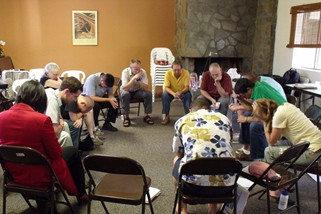
The story of TENT Norway

http://globalopps.org/tmbriefs/Tent%20meeting%20room2_small.jpg

TENT of Norway was founded in 2001 by a team of dedicated people, a strong board and effective former tentmaker, Steinar Opheim. Instead of figuring it out alone, they invited Global Opportunities to help them with resources and teachers for their courses.

An early indication of God’s favour was made evident when TENT was able to purchase a historical prayer house building right in downtown Bergen for one dollar. These historical prayer houses were built  using volunteer labor by everyday workers who needed a place to worship. Thus the location in the port area where most work activity took place in the early days of this prayer house movement.


Although the cost of the building was one dollar, the renovations that were needed were more than even the highest estimates. This being a historical building meant that the exterior could not be changed and had to remain original. The interior was completely redesigned with the addition of offices in the loft area and converting the open basement into a rental unit and kitchen. The general meeting room is large and bright, with excellent air circulation and comfortable seating. Wireless internet is available to all as well.
 

TENT is able to rent this facility when not being used for tentmaking events, which helps in making payments on the renovation costs. After the renovations loan is paid off, this income will go a long way toward adding much needed staff to this growing organization.

Why not join us for the next tentmaking business as mission course at this beautiful location? You will be housed for free in local Christians homes, all meals and snacks are included in the low course fee.

TENT is also looking for donations toward the renovation loan, if you are able to help or know someone with Norwegian genes who might want to support this work in a meaningful way, please contact Steinar Opheim directly by sending him an email at: steinar@tent.no

Business as Mission: A Threefold Mandate

http://globalopps.org/tmbriefs/workingpeople2.gif

Guest Editor Mats Tunehag
 

Business is more than making money, at least it should be. According to the “father of capitalism” Adam Smith, businesses exist to serve the general welfare.

The computer pioneer Dave Packard said:”Many people assume, wrongly, that a company exists simply to make money. While this is an important result of a company’s existence, we have to go deeper and find the real reasons for our being. People get together and exist as a company so that they are able to accomplish something collectively that they could not accomplish separately – they make a contribution to society.”

In the last 12 – 18 months we have been able to witness the effects of a global economic crisis. Mahatma Gandhi’s list of seven deadly social sins seems to be an accurate diagnosis for some of the causes of this crisis. It has been too much…

 1.  politics without principle
 2.  wealth without work

 3.  commerce without morality

 4.  pleasure without conscience

 5.  education without character

 6.  science without humanity

 7.  worship without sacrifice

The Christian social activist Jim Wallis wrote about the economic crisis: “How will this crisis change us? How will it change the way we think, act, and decide things – how we live, and how we do business? Yes, this is a structural crisis, and one that clearly calls for new social regulation. But it is also a spiritual crisis, and one that calls for new self-regulation. We seem to have lost some things and forgotten some things — such as our values.”

We cannot, and must not, go on assuming and practicing business as usual; neither the extreme Wall Street way, nor the centrally planned socially engineered way.

Business is multi-faceted. It is about profit and values, about wealth creation and social concern, about value added products and services and creation care, about markets and caring for people. But Business as Mission, BAM, is more than just Corporate Social Responsibility (CSR), it is more than job creation and entrepreneurship. BAM, is about being a follower of Jesus in the market place. BAM businesses also want to see Christ revealed and God glorified among all peoples and nations.

For Business as Mission rests on three distinct Biblical mandates:

1. The creation mandate is to “till, care for, exercise stewardship, multiply, work, prosper”. This is about being creative; create good things for ourselves and others – also in and through business.  This also means being good stewards of our talents, resources and callings, but also caring for creation and people. It is also acknowledging and affirming the gifts and calling of entrepreneurs.
 

2. The great commandment mandate is to “love your neighbor as yourself”. We know that business can and should serve people and meet various needs. For example: Unemployment is a major underlying cause to malnourishment and starvation, homelessness, disease and limited access to medical treatment, as well as to debt and crime. Providing people with jobs is alleviating and preventing these dire conditions.
 

3. The great commission mandate is to “make disciples of all nations”. As followers of Jesus we have a global mission – to all peoples.  BAM has a missional and global intent. BAM takes B and M seriously: real business and intentional mission, especially to areas with dire spiritual, economical and social needs. BAM businesses want to see Christ revealed and God glorified, in and through business, among all peoples and nations.
 

These three mandates must be at the forefront when we plan and run BAM businesses. It is equally important that these three serve as a context as we continuously evaluate our practical BAM mission. We must be aware of the risk of mission drift. One may start out with high hopes and ambitions regarding all three mandates, but eventually end up just operating a CSR business, only fulfilling the creation mandate and the great commandment mandate. As good as that may be for various stakeholders, it is nevertheless a shortcoming. Our unique contribution and responsibility as BAMers rests on the threefold mandate.

Just doing business for maximization of profit is also a mission drift. That limited understanding and praxis of business contributed towards the global recession. Mahatma Gandhi’s observations are important as we seek the general welfare of society. Finally, as Christians in the market place we strive to do business as unto the Lord, being accountable to Him and to fellow followers of Jesus.

      © Mats Tunehag                 

       February 2010

       Lausanne Senior Associate – Business as Mission

       World Evangelical Alliance Mission Commission Associate – Business as Mission

The Wheaton Declaration

In October 2009 we organized a global consultation on Business as Mission, BAM, under the theme ‘Business as Integral Calling’. The Consultation, held in Wheaton, Illinois USA, was a significant contribution to equip many on the journey towards a better understanding and praxis of BAM.

We came from sixteen countries and five global regions “to explore the place of business in God’s purposes, together with the sacred calling of a life in business. 
We began with an acknowledgement of God’s sovereignty and Lordship over all aspects of human life, including our work, our business, our money, our profit, our economy, and our working relationships.”

Our conversations were organized around topics like:

  • What challenges and opportunities confront business seeking to 
    implement Kingdom values?
  • How does an understanding of the Kingdom of God re-center and 
    anchor business?
  • From a Kingdom of God perspective, how should business, in conjunction 
    with non-governmental organizations and government agencies, address poverty?
  • How do businesses with Kingdom values operate within environmental and 
    natural resource constraints?

The Wheaton Consultation brought together leaders from the realms of business, non-profit organizations, and Christian ministry with theologians and academic leaders in business, economics, and missions.

The Consultation sought to build upon the Lausanne process and document.**

Our deliberations are summarized in the Wheaton Declaration.

One brief excerpt:

“It is our deep conviction that businesses that function in alignment with the core values of the Kingdom of God are playing and increasingly should play an important role in holistic transformation of individuals, communities and societies.”

Mats Tunehag

Lausanne Senior Associate Business as Mission

What GO Courses Do to People

http://globalopps.org/tmbriefs/pas.png

Global Opportunities has been running our GO Equipped! tentmaking courses for over 10 years now. They do things for people and they do things to them.

It gets them over the hump.

Those who’ve been considering tentmaking begin to imagine themselves actually doing it. They begin to see themselves actually finding a job overseas, leaving their job here, living and connecting with the people, and opening their hearts and home to them.

R & D attended a course in Victoria, BC, Canada and started seriously searching for teaching jobs. About a year later they began teaching in an international school in Beirut.

Michelle just attended our Pasadena course in October and is heading to Asia later this year to teach.

It gives them understanding of how everyday Christians can do ministry. It provides a new Biblical model of work-faith integration which leads to their saying, “Aha. I could do that!”

MB had been a tentmaker in Uzbekistan. Then an incredible door opened to one of the most oppressive and needy countries on earth. But he was scared he could not share Christ there. Ari and I both urged him on and he accepted the invitation. On his way there, he made time to attend our course in Pasadena. It helped him gain insight into how he could witness even there and he has had remarkable impact.

It refocuses them and opens new windows.

Sergio & Angela were heading to Thailand to serve in a children’s home. They had a great heart to serve even though this required support funds. At a Fort Myers course, they saw a whole new perspective and Sergio ended up using his science and engineering skills to teach in a high school in Thailand.

Chris came to a Pasadena course after serving as a missionary in Thailand. With strong people and teaching gifts, he saw the power of using them in tentmaking, earned a PhD and returned to Thailand to teach English.

It equips them to be effective by focusing on core principles and ministry skills.

Jon & his wife attended the course in Dallas. In late summer they moved to India to start an outsourcing business which employs both believers and non-believers. His leadership has improved employees’ work habits and helped some to Christ. He said that “The course must have been developed out of years of experience in the field. I still draw on it—the importance of jumping right into the culture, living out what I believe during day-to-day business, of opening up the home… I could go on. The course was truly sent by God at just the right time…”    

It gets them overseas as tentmakers. Around 50% end up overseas. Coming can be dangerous!